Arabic Arts Alive Storytelling Two at Radio 5EBI Auditorium
“Arabic Arts Alive 2025” run by The Arabic Language and Culture Association (ALCASA) in partnership with the History Trust of SA Migration Museum is a project aiming to bring people together through music, dance, and storytelling.
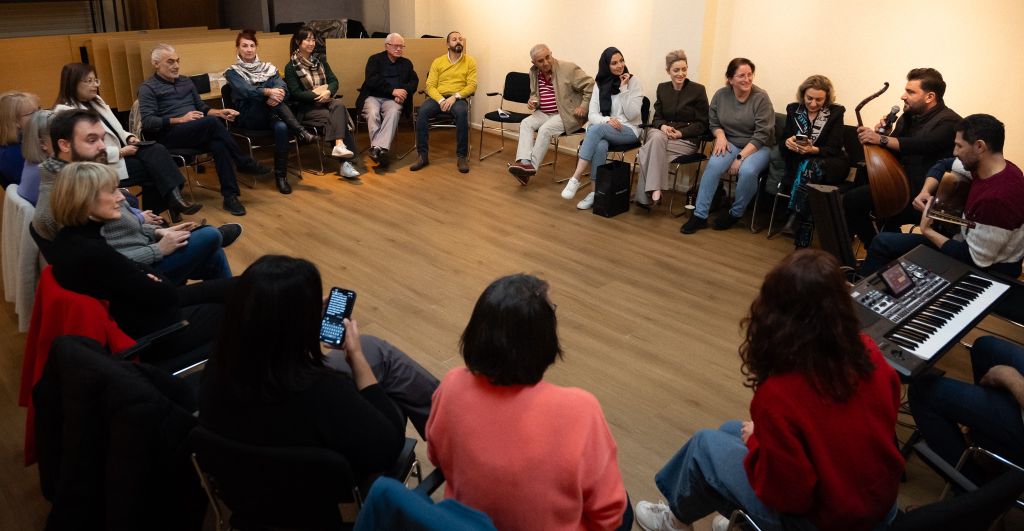
The second workshop was held on July 4th in a heart-warming display of community and joyous sharing of personal stories about Arabic music and dance. Some contributions were planned and some spontaneous, but each was an ingredient in a cocktail of participation and enthusiasm.
There were renowned singers and those who had newly discovered their voices. There were dancers, both professional and amateur. Maher Najjar exemplified the style and grace of a professional dancer while in others there was just an exuberant display of people having fun together.
Some stories dealt with the importance of music in the family. Grace Eliseo spoke of a religious hymn by her late father. She recited a poem highlighting how music reminded her of her childhood and the music which played in the family car, and how this music continues to have a role in her life whether she is happy or sad.
Raniah Daou felt that music was a kind of magical refuge – a place to escape to when life’s pressures piled up. She said that she loved the old traditional songs which never die. This shared appreciation of traditional songs led to spontaneous renditions by the other musicians when a popular tune was mentioned, accompanied by clapping and broad smiles of recognition.
The theme of music and dance shaping cultural identity was always present. Doris Abboud felt that Arabic music and rhythms were a bridge returning her to memories of family gatherings, weddings and village festivals in Lebanon, and stories which had been passed down from generation to generation. Many made this connection between music and memories.
Wael Said introduced a literary flavour when he spoke of Marcel Khalifa’ s musical rendition of a poem by Palestinian poet, Mahmoud Darwish. The poem, ‘Passport’, focuses on attempts to separate the poet from his homeland by taking away his passport. In response, Darwish asserts that his identity does not depend on a document, but is connected to the land, people and heritage he loves. This was something everyone could relate to.
This was an evening where music and dance transcended language barriers. Lenard Sciancalepore remarked that for him attending ALCASA events meant hospitality, passionate music and songs, and dancing together as one community. He asked, “Why wouldn’t you want to be involved?”
And who could argue with that?
Bridget Smith
Arabic Arts Alive 2025 , a project by the Arabic language and culture Association of SA (ALCASA) in partnership with the History Trust of SA Migration Museum
Proudly supported by a City of Adelaide Arts and Cultural Grant
SHARE